
GPU Clusters
High-performance GPU clusters and on-demand VMs optimized for AI and ML workloads.

KLOUD SOLUTIONS INC.
Automated cloud infrastructure for GPUs, virtual CPUs, dedicated bare metal, Kubernetes, storage, backups, SDN networking, and secure sovereign collaboration.

High-performance GPU clusters and on-demand VMs optimized for AI and ML workloads.

Deploy cost-effective VM instances for web, enterprise, analytics, and application workloads.

Scale workloads into public clouds with custom policies and trigger events when demand spikes.

Build, automate, and integrate infrastructure operations through platform APIs and portals.
Products
Explore compute, GPU, Kubernetes, storage, backups, networking, cloud bursting, and managed services with clear guidance for enterprise, government, AI, and service-provider workloads.
AI and ML
Run AI training, deep learning, inference, LLM development, GPU notebooks, and HPC workloads without buying dedicated GPU infrastructure.
General purpose and optimized instances for applications, ERP, databases, development, and production hosting.
Orchestrate containers, scale services, and support GPU-accelerated workloads across private, edge, and multi-cloud environments.
Dedicated single-tenant servers for workloads that need full control, predictable performance, and hardware-level isolation.

Object storage, block storage, snapshots, backup services, immutable recovery patterns, and data lifecycle support.

Virtual private cloud, firewalls, load balancers, secure networks, private access, and software-defined connectivity.
Virtual machines give teams configurable compute without waiting for physical hardware. They are suited for application servers, ERP systems, development environments, databases, web hosting, and controlled migration from legacy infrastructure.
Kloud value: provision cost-effective VM sizes, attach storage, place workloads inside private networks, and manage them through dashboard, API, monitoring, snapshots, and support.
GPU VMs combine normal server resources with NVIDIA acceleration so AI teams can train models, run inference, render media, process large datasets, and test ML workloads without owning GPU servers.
Kloud value: on-demand access to GPU capacity, scalable consumption, and a path from notebooks and prototypes into production GPU services.
Bare metal provides a dedicated physical server for workloads that need single-tenant isolation, predictable performance, direct hardware access, compliance separation, or specialized GPU/CPU/storage profiles.
Kloud value: dedicated GPU and CPU servers that can be automated and connected to the same cloud operating model as virtualized services.
Kubernetes is the orchestration layer for containerized applications. Managed Kubernetes reduces the burden of cluster setup, scaling, health checks, upgrades, and day-to-day operations.
Kloud value: managed clusters for cloud-native applications, GPU workloads, service scaling, and environments that need consistent deployment across private, public, and edge infrastructure.
Multi-cloud clusters let organizations span container workloads across private clouds, public clouds, on-premise environments, and geographically distributed locations.
Kloud value: use FusionFlow to create and manage clusters, add worker nodes across providers, monitor metrics, and keep application teams using familiar Kubernetes tools.
GPU notebooks provide a browser-based workspace for data science, model experimentation, documentation, code, visualizations, and collaboration.
Kloud value: launch notebook environments in seconds, start/stop sessions as needed, choose sizes and images, and collaborate without local workstation setup.
Public cloud resource provisioning lets teams consume AWS, Azure, Google Cloud, Oracle, or other external capacity when workloads need global scale, specialized services, or temporary burst capacity.
Kloud value: use one dashboard and operating model to combine private Kloud capacity with approved hyperscaler resources.
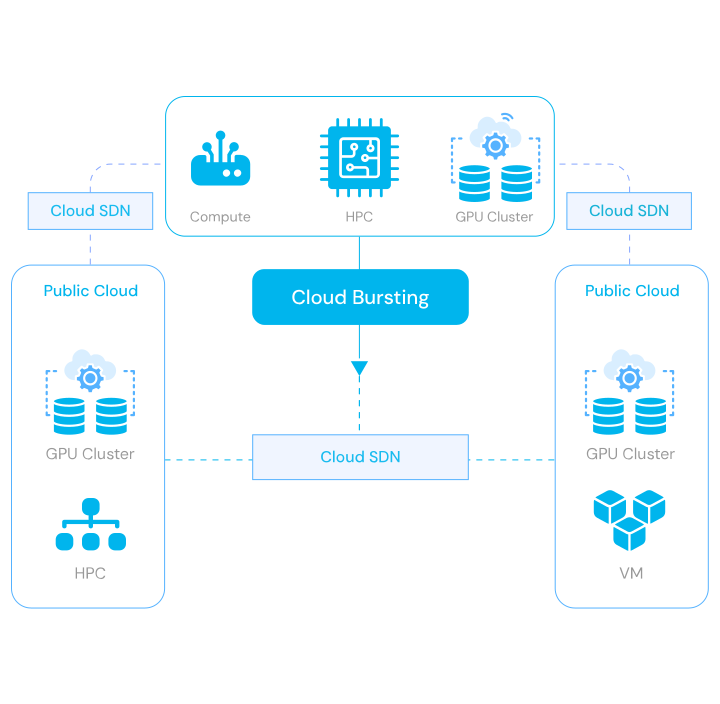
Cloud bursting automatically expands workloads into public cloud resources during high demand, then returns them to normal capacity when the peak passes.
Kloud value: policy-based triggers, on-demand provisioning, resilience during spikes, cost-aware placement, and access to hyperscaler capacity without making every workload public-cloud-first.
Object storage is designed for unstructured data such as backups, archives, images, documents, datasets, media, and application assets. It stores data as objects that can be accessed through APIs.
Kloud value: scalable storage for content repositories, archives, backup targets, logs, records, AI datasets, and large document collections.
Block storage provides persistent volumes that behave like disks attached to compute instances. It is a good fit for databases, VM boot volumes, transactional applications, and performance-sensitive workloads.
Kloud value: attachable volumes for VMs and cloud services, with snapshots, backup policies, and lifecycle operations.
Backups protect workloads for recovery after deletion, corruption, cyber incidents, failed updates, or infrastructure problems. Snapshots preserve point-in-time VM or volume state for rollback and migration.
Kloud value: backup, snapshot, recovery, retention, and DR patterns that support production operations instead of one-off manual copies.
Cloud networking connects and protects workloads. VPCs isolate resources, firewalls control traffic, load balancers distribute demand, and SDN makes network behavior programmable.
Kloud value: private tenant networks, secure access, traffic control, application delivery, and software-defined services that can be automated through the platform.
Cloud deployment models
KloudPH can meet customers where their data, compliance, and procurement model require them to operate: public cloud consumption, private cloud delivery, government cloud licensing, bare metal leasing, or on-premise infrastructure leasing for sensitive workloads.
KloudPH public cloud gives customers on-demand access to compute, GPU services, storage, Kubernetes, networking, backups, and service-provider operations through FusionFlow as the underlying cloud service platform.
It is suited for enterprises, developers, AI teams, agencies, and service providers that want Philippine-hosted cloud capacity without building and operating the entire platform themselves.
KloudPH can deliver private cloud environments as a turn-key project or through a licensing model. This gives organizations their own cloud platform while still benefiting from FusionFlow's multi-tenant service catalog, identity, billing, quota, policy, and automation capabilities.
Government cloud licensing supports agencies that need sovereign control, policy governance, auditability, delegated administration, and repeatable cloud services across departments, regions, or government data centers.
For enterprises that must keep sensitive information on-premise, KloudPH can offer bare metal lease and on-premise infrastructure lease models. Customers keep workloads close to their controlled environment while gaining cloud-style provisioning, monitoring, backup, and lifecycle operations.
The strategic advantage is continuity across environments. A private or government on-premise cloud can extend into KloudPH public cloud when demand spikes, capacity is constrained, a disaster recovery plan is activated, or a project needs temporary GPU, compute, storage, or Kubernetes capacity.
This turns cloud bursting into a practical operating pattern: keep sensitive baseline workloads on-premise, then expand seamlessly into Philippine-hosted public cloud capacity under the same service model.
FusionFlow + ConnectBridge
FusionFlow brings together self-service portals, tenant management, service catalogs, policy controls, usage metering, GPU scheduling, Kubernetes, billing, and operations visibility. It gives KloudPH a common operating layer for public cloud services, licensed private cloud, licensed government cloud, bare metal lease, and on-premise infrastructure lease models.
FusionFlow deep dive
FusionFlow is the cloud service platform layer that turns infrastructure into a managed catalog with portals, policy controls, billing, monitoring, security, and automation.
FusionFlow can expose a branded public-facing cloud portal where customers discover services and register for access. The administrative CMS allows the operator to update pages, layouts, and branding as products evolve.
The service portal manages tenants, users, roles, policies, billing, account controls, and access to the user portal. For enterprise and government programs, this gives administrators delegated control instead of a purely manual support process.
The user portal is where customers consume cloud services: virtual machines, bare metal, GPU virtual machines, notebooks, Kubernetes clusters, storage, and network services. It is the self-service layer that makes infrastructure feel like a product.
The admin console controls tenancy, SKUs, products, resources, configurations, policies, and platform operations. This matters for Kloud because products can be packaged for government, enterprise, telco, and partner channels.
FusionFlow supports usage tracking, SKU management, billing data ingestion, invoice-ready metrics, and integration with third-party billing systems. It can meter GPUs, nodes, volumes, backups, snapshots, elastic IPs, load balancers, and other services.
FusionFlow supports GPU virtual machines, GPU notebooks, GPU scheduler concepts, Kubernetes-based AI workloads, and scalable GPU resource pools. This lets Kloud move AI teams from experimentation into production infrastructure.
FusionFlow can create Kubernetes clusters, integrate volumes and load balancers, add worker nodes from managed providers, expose monitoring dashboards, and keep standard Kubernetes tooling available to developers.
FusionFlow is positioned to connect environments across data centers, public cloud, private cloud, and edge locations. For KloudPH, this supports a public cloud that can absorb temporary demand from private and government on-premise clouds.
FusionFlow supports operational visibility across uptime, responsiveness, latency, packet loss, device health, platform services, utilization, and service availability. The platform can support 24/7 operations with escalation tiers.
ConnectBridge
ConnectBridge complements FusionFlow by turning networking into an on-demand service portfolio. It is designed for service providers, enterprises, and public-sector agencies that need private connectivity without building every network function from scratch.
Cloud Connect provides secure connectivity between customers and public cloud environments. It supports a practical hybrid-cloud model: use KloudPH for local control and connect to hyperscalers when a workload or service requires it.
Office Connect uses standard IPsec patterns to connect branch offices or entire office networks into the ConnectBridge fabric using existing routers and firewalls, avoiding unnecessary hardware replacement.
App Connect grants controlled access to SaaS applications and selected URLs or endpoints. It can pair access rules with SSO links so users reach approved applications from a familiar dashboard.
Client Connect lets mobile and desktop users connect safely into the global ConnectBridge network and reach authorized networks or applications from wherever they work.
Port Connect provides private high-capacity data center entry points with routing options such as BGP or static routing, supporting enterprise and carrier integrations.
CB Link creates private inter-region or inter-PoP paths with selectable circuit providers, bandwidth options, routing constraints, and demand-based pricing models.
Solutions
Kloud gives teams immediate access to GPU infrastructure for AI models, machine learning, rendering, analytics, and data science environments.
Run websites, WordPress, ERP platforms, custom applications, databases, and secure collaboration spaces on Philippine-hosted infrastructure with monitoring and support. Customers can start on KloudPH public cloud or deploy a private cloud when dedicated control is required.
For agencies and regulated enterprises, KloudPH combines local hosting, data residency, secure collaboration, identity, audit, backup, and managed migration into a practical sovereign cloud path. Government cloud can be licensed for agency-controlled environments while still retaining the option to burst into KloudPH public cloud.
Telcos, ISPs, CSPs, and platform providers can use FusionFlow and ConnectBridge to deliver white-label cloud, SDN, private connectivity, marketplace services, and usage billing.
Technology explainers
Use these explainers to understand how KloudPH services map to common enterprise, government, AI, and service-provider requirements.
Kubernetes automates the deployment, scaling, and management of containerized applications. In practice, it gives development teams a repeatable way to run microservices, APIs, background workers, ML services, and web applications across a cluster instead of manually managing each server.
Managed Kubernetes adds operational support around the cluster: provisioning, upgrades, monitoring, autoscaling, load balancing, networking, storage integration, and security controls. For Kloud customers, this means developers can focus on applications while Kloud manages the platform foundation.
Autoscaling adjusts application capacity based on observed demand. In Kubernetes, horizontal autoscaling changes the number of running replicas based on metrics such as CPU, memory, or custom signals.
Cloud bursting applies the same elasticity idea across environments. A workload normally runs on private or local capacity, then expands into public cloud resources during demand spikes. KloudPH cloud bursting helps customers gain resilience and scale without permanently overbuying infrastructure.
Modern AI and high-performance computing use GPUs because they can process many parallel operations efficiently. NVIDIA H100 and H200 class GPUs are built for generative AI, LLMs, analytics, inference, model training, and scientific workloads.
Kloud can present GPU resources as GPU VMs, notebooks, Kubernetes workloads, or bare-metal GPU servers. That lets customers choose the right operating model: experimentation, shared data science, production inference, or dedicated high-performance infrastructure.
Object storage stores data as API-addressable objects. It is excellent for backups, archives, datasets, documents, images, logs, static assets, and records where scale and durability matter more than disk-like behavior.
Block storage provides persistent volumes that can be attached to compute instances, similar to disks. It is better for VM boot disks, databases, transactional systems, and workloads that expect a filesystem or raw disk device.
A Virtual Private Cloud is a logically isolated network where cloud resources can run with defined address ranges, subnets, gateways, and access controls. It gives cloud workloads a network structure similar to an on-premise data center, but programmable.
Firewalls and security rules define which traffic is allowed between users, applications, subnets, services, and the internet. For Kloud, VPC and firewall services are core to secure cloud hosting and government-ready landing zones.
Software-defined networking separates network control from individual forwarding devices. Rather than configuring every network element separately, an SDN controller or platform can apply policies and routes centrally.
For Kloud and ConnectBridge, SDN means networking can be delivered like a cloud service: private links, application access, cloud connectivity, routing policies, load balancing, and security services become programmable, measurable, and easier to operate.
Nextcloud provides file sync and share, office collaboration, groupware, Talk, calendars, contacts, forms, decks, and related collaboration tools that can be self-hosted under an organization's control.
Nextcloud Flow adds low-code and no-code automation for routine work. It can trigger actions, route files, reduce manual handling, and turn storage into a workflow engine. For KloudPH, this supports government and enterprise teams that want collaboration under Philippine jurisdiction.
Snapshots capture the state of a VM or volume at a point in time, making rollback and cloning easier. Backups are broader recovery copies designed for deletion, corruption, failed upgrades, ransomware scenarios, and long-term retention.
Disaster recovery adds the operating plan: where copies are stored, how fast systems can return, which workloads are prioritized, and how often recovery is tested. KloudPH treats backup and DR as an operational discipline, not just a storage checkbox.
Industry solutions
KloudPH supports government, healthcare, enterprise, telco, AI, developer, and SaaS use cases with cloud infrastructure designed around control, performance, and operating continuity.
Public agencies need digital services that preserve data control, withstand usage spikes, and remain practical for local IT teams to operate. KloudPH supports government cloud programs through Philippine-hosted infrastructure, private or on-premise deployments, and a path to extend workloads into public cloud capacity when demand grows.
AI teams need fast access to GPU capacity, controlled datasets, and repeatable environments for experimentation and production. KloudPH can provide GPU VMs, GPU notebooks, Kubernetes-based AI pipelines, and dedicated GPU infrastructure without forcing teams to purchase and operate their own servers upfront.
Service providers need a way to package infrastructure, connectivity, billing, and support into repeatable customer offerings. With FusionFlow and ConnectBridge, KloudPH can help providers launch branded cloud services, manage multiple tenants, connect partner networks, and extend private infrastructure into public cloud resources.
Enterprises need predictable cloud capacity for applications that cannot tolerate uncertain residency, cost, or support. KloudPH supports VM migration, private cloud licensing, bare-metal lease, on-premise infrastructure lease, and managed operations for organizations that need sensitive workloads to stay close to their data owners.
Healthcare organizations need infrastructure that treats patient records, imaging, telemedicine, and continuity as operational priorities. KloudPH can host sensitive systems in Philippine-controlled environments, connect facilities privately, and provide resilient backup and disaster recovery designs for clinical and administrative platforms.
Software teams need environments that let them build, test, deploy, and scale without slowing down on infrastructure tickets. KloudPH supports developer-ready VMs, Kubernetes, APIs, load balancers, CI/CD-friendly environments, and observability for teams building modern applications in the Philippines.
Platform momentum
KloudPH focuses on Philippine-hosted cloud, sovereign control, hybrid operations, AI infrastructure, and secure connectivity for organizations that need dependable local cloud capacity.
FusionFlow supports heterogeneous cloud systems, multi-tenant workloads, IaaS, PaaS, BMaaS, virtual machines, and disaster recovery under one service platform.
SkyLab partnershipThe KloudPH and SkyLab partnership brings digital sovereignty, local deployment, and scalable cloud services into a Philippine-hosted operating model.
FusionFlowSkyLab positions FusionFlow as a unified, vendor-agnostic, multi-tenant platform for service providers, enterprises, and public sector teams across data centers, public cloud, private cloud, and edge.
ConnectBridgeConnectBridge acts as the network layer for offices, data centers, public clouds, SaaS platforms, mobile users, and service-provider interconnection services.
2026 recognitionFusionFlow simplifies deployment and governance for cloud, edge, and AI infrastructure across regions and operating environments.
Nextcloud FlowNextcloud can operate as more than file storage by adding workflow automation, task routing, and streamlined collaboration for controlled teams.
Private hostingKloudPH gives Philippine enterprises on-shore, cost-conscious cloud power without giving up ownership and operational control.
Application lifecycleKloudPH infrastructure supports business outcomes such as better software delivery, real-time insights, automation, and scalable operations.
PH-hosted operationsKloudPH delivers practical local cloud services backed by 24/7 monitoring and managed support.
Delivery model
Kloud can meet clients at the infrastructure, platform, application, or managed operations layer, then phase the rollout in a way that protects service continuity.
Inventory apps, data, users, network, compliance, and operating constraints.
Create the VM, GPU, Kubernetes, storage, SDN, security, and backup design.
Provision resources, migrate workloads, validate performance, and train teams.
Monitor, optimize, secure, back up, and report on cloud health and usage.
Reserve Capacity
Submit the initial sizing, contact details, and target timeframe. Valid requests are routed into the sales prospect pool; requests that need clarification are flagged for Sales Manager review.
Contact Us
For infrastructure, GPU, Kubernetes, SDN, Nextcloud, private cloud, government cloud, or service-provider platform discussions, contact the Kloud team.
207 Parc Chateau, 5 Onyx Road
San Antonio, Ortigas Center
Pasig City, Metro Manila 1605